
Like the varied niches within the coaching profession, multiple certifications help you level up and shape into an accomplished coach. The ICF accredited coaching certificate programs are necessary for an individual to learn and imbibe the coaching competencies and inculcate the profession’s code of ethics. It lays the foundation, not to mention, is integral to getting credentials as a coach after certification. There are three types of certificate programs that one can avail of, which are:
- Associate Certified Coach (ACC)
- Professional Certified Coach (PCC)
- Master Certified Coach (MCC)
In this blog, we will talk about ICF PCC certificate programs, what they are made of, and the certificate’s relevance.
What is PCC?
Professional Certified Coach (PCC) is a comprehensive coach training program for coaching aspirants. The course demonstrates the core competencies of coaching, going a level ahead of the foundational courses. PCC training programs help aspirants become proficient in applying ICF standardized competencies and understand the code of ethics.
What is the Duration and Course Structure of PCC Certificate Programs?
PCC certificate holders are known to demonstrate high ethical standards in coaching, along with a commitment towards upholding the standards set by ICF. They have to undergo rigorous evaluation to prove their competence through their approach and skills. A lot of these attributes get imprinted into an aspirant when he/she undergoes the training program. The total break-up of the PCC certificate training programs is as follows:
- Duration: 125 hours (total)
- 100 hours of face-to-face coach-specific training
- 25 hours of assignments and fieldwork
- 10 hours of mentor coaching are also included in the module. It is mandatory for the credentialing process.
- Fast-track: 10 days, Regular: 30 Weeks
What are the requirements of PCC Credentials?
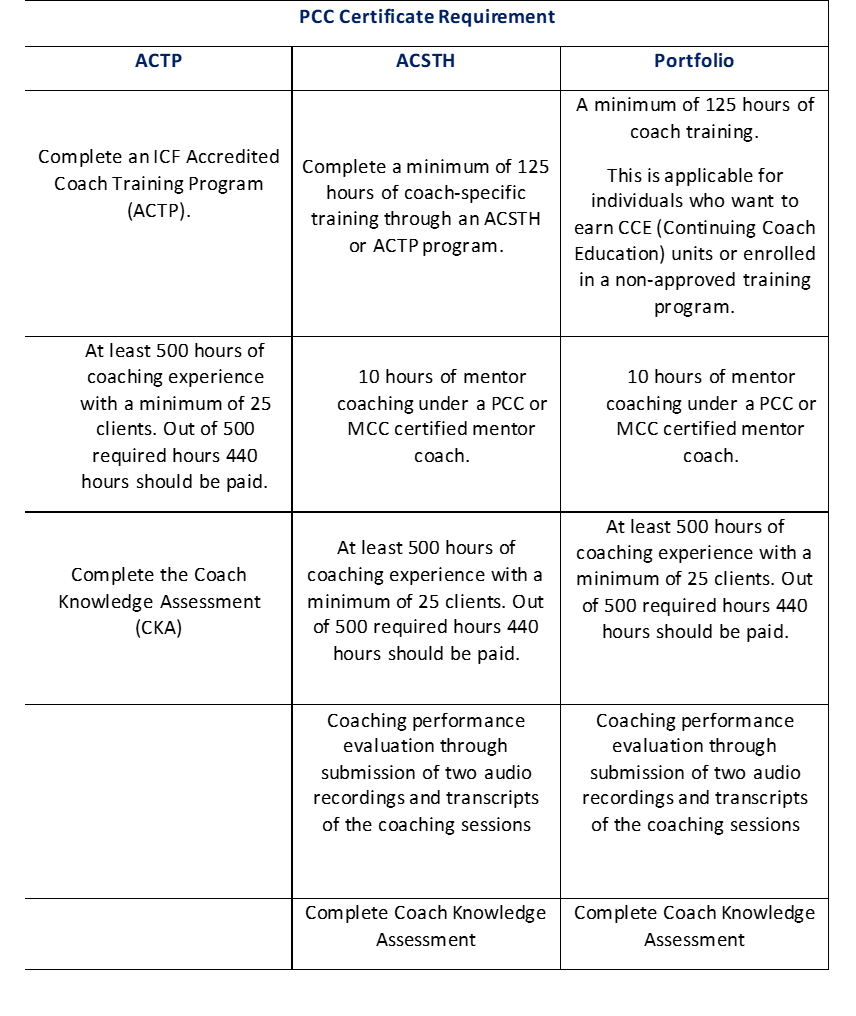
The PCC certification has 3 pathways:
- PCC ACTP (Accredited Coach Training Program)
- PCC ACSTH (Approved Coaching Specific Training Hours)
- PCC Portfolio (Continuing Coaching Education)
After completing the coach-specific training, the next step is to complete your mentoring. Along with mentoring, you can start working towards achieving your coaching experience. For a PCC certificate, you need at least 500 hours of coaching experience.
Conclusion
If you are seeking a credible training institute to get your PCC certification, then Team Transformation is the place to start with. Team Transformation provides ICF-approved PCC certification programs for aspiring coaches and leaders. Team Transformation also provides specialization courses in Team Coaching, Executive Coaching, Leadership Coaching, and Organizational Coaching.
Contact us to know more about our ICF-approved coach training programs.